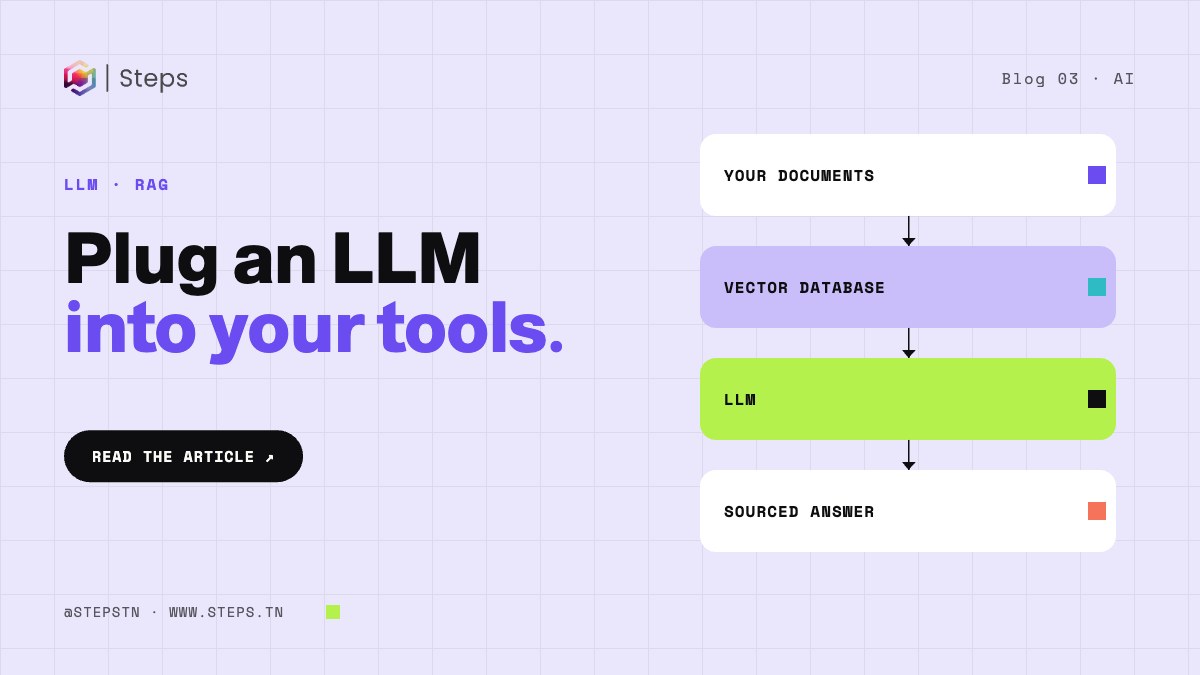

Integrating an LLM (large language model, like those behind conversational assistants) into your business tools means connecting the model to your data and applications so it answers with your information, in your screens, following your rules. The most common method is called RAG: the system first retrieves the relevant documents from your base, then asks the model to write an answer grounded in those documents.
The most profitable use cases
- Internal knowledge assistant: answering team questions from procedures, contracts and guides.
- Augmented customer support: suggesting answers to agents, summarising a customer’s history.
- Document processing: extracting information from invoices, forms or letters.
- Assisted writing: proposals, meeting notes, product sheets from templates.
- Smart search: finding information across thousands of documents by asking a question in plain language.
How a RAG architecture works
- Preparation: documents are split into passages and turned into numerical representations stored in a vector database.
- Retrieval: for each question, the system finds the closest passages.
- Generation: the LLM writes the answer from these passages and can cite its sources.
- Control: rules filter off-topic answers and enforce each user’s access rights.
The benefit of RAG: the model does not need retraining, and updating a document is enough to update the answers.
Choosing the right model
The choice depends on three criteria: expected quality, cost per request and confidentiality. Commercial models available through APIs offer top quality and fast setup. Open models hosted on your infrastructure give more control over data, at the price of heavier operations. Many companies combine both depending on data sensitivity.
Security and confidentiality checklist
- Is data sent to the provider excluded from model training?
- Where is processing hosted?
- Does each user only see the documents they are entitled to?
- Are exchanges logged for audit?
Steps of an integration project
- Scoping the use case and success metrics.
- Auditing data sources: quality, formats, access rights.
- Prototype with a sample of documents and a pilot group of users.
- Evaluation of answer quality on a reference question set.
- Production: integration into existing tools, monitoring, team training.
STEPS expertise
STEPS builds LLM and generative AI applications integrated into its clients’ tools, backed by solid data engineering upstream. To identify the most profitable use case in your organisation, book a scoping session.
Frequently asked questions
RAG (Retrieval-Augmented Generation) first retrieves relevant documents from your base, then asks the LLM to write an answer grounded in them, which limits errors and allows sources to be cited.
In most cases, no. A RAG architecture lets the model use your documents without retraining, and updating documents is enough.
Yes if you choose a provider that does not use your data for training, suitable hosting, per-user access rights and logging of exchanges.
A prototype on a specific use case takes a few weeks. Production depends on the number of tools to connect and security requirements.