
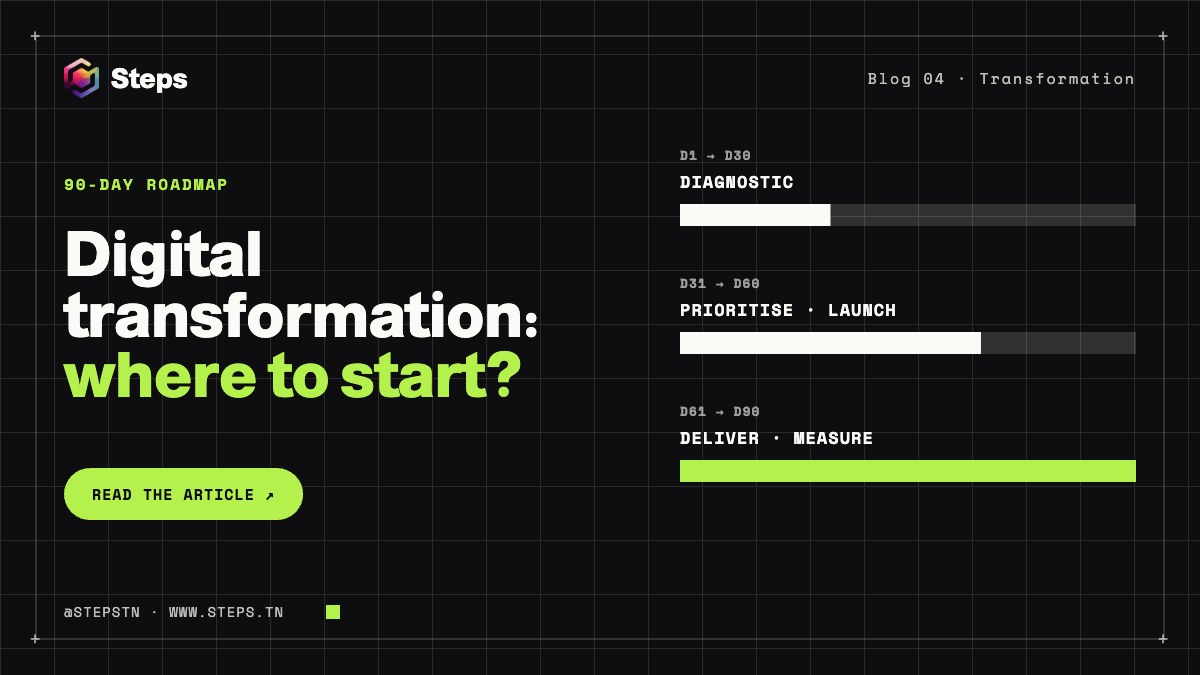

To start a digital transformation, begin with business problems, not tools: identify the processes that cost the most time or money, choose one or two high-impact projects, then deliver a first measurable result in less than three months. This avoids large programmes that run out of steam before creating value.
Why so many transformation projects fail
The causes are almost always the same: a scope too broad from the start, buying tools before defining needs, low team involvement and no indicators to measure progress. Technology is rarely the real problem.
Days 1 to 30: diagnosis
- Map key processes: sales, customer relations, production, finance, HR.
- Spot pain points: double data entry, shared Excel files, response delays, recurring errors.
- Inventory tools and data: what exists, what is used, what does not connect.
- Listen to teams: they know the real blockers.
Deliverable: a list of projects ranked by impact and difficulty.
Days 31 to 60: prioritise and launch
Pick one or two projects that combine visible impact and fast delivery. Typical examples:
- Replacing an Excel tracker with a simple web application.
- Setting up a management dashboard connected to existing data.
- Automating a repetitive process, possibly with an AI agent.
- Redesigning a website so it generates qualified leads.
For each project, set a quantified success indicator: time saved, shorter lead time, revenue generated.
Days 61 to 90: deliver, measure, decide
Deliver a first usable version, even partial, and measure the chosen indicator. After 90 days you have a concrete result, a convinced team and a solid basis to decide the next projects.
Mistakes to avoid
- Trying to transform everything at once.
- Choosing software before describing the need.
- Forgetting user training and support.
- Neglecting data quality, which conditions every analytics and AI project.
Where does artificial intelligence fit?
AI is not a separate step: it accelerates existing projects. Once data is accessible and processes are clear, an AI agent or an LLM-based assistant can take over part of the repetitive tasks.
How STEPS supports this approach
Since 2012, STEPS has helped companies in every sector with digital transformation and AI integration, from diagnosis to custom development and dashboards. To build your roadmap, book a scoping session.
Frequently asked questions
Start with a diagnosis of the processes that cost the most time or money, then choose one or two high-impact projects that can deliver a measurable result in under three months.
It is continuous, but first results should arrive within about 90 days. After that, projects follow one another according to priorities.
AI works best when data is accessible and processes are clear. It can be part of the first projects if those conditions are met.
Time saved on targeted processes, processing delays, error rate, adoption of new tools and impact on revenue.