
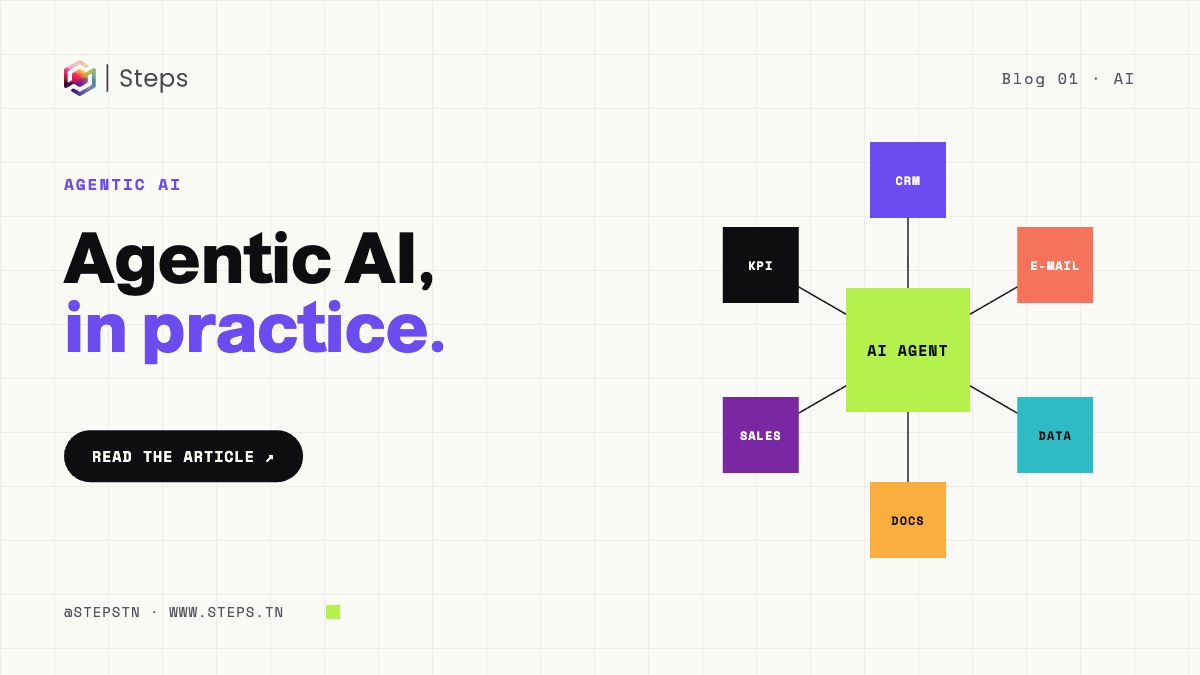

Agentic AI refers to artificial intelligence systems that can carry out a task end to end: they understand a goal, plan the steps, use your tools (CRM, ERP, email, databases) and report on the result. Where a chatbot answers a question, an AI agent handles a case. For a business, it is the shift from AI that advises to AI that saves time on real processes.
AI agent or chatbot: what is the difference?
A classic chatbot follows a script or generates an answer from text. An AI agent adds three capabilities:
- Action: it calls tools and APIs (create a ticket, update a customer record, send a quote).
- Planning: it breaks a goal into steps and adapts depending on the results.
- Context: it relies on your documents and internal data, not only on general knowledge.
In practice, a chatbot can explain your refund policy. An AI agent can check the order, verify eligibility, prepare the refund and ask for human approval before executing it.
Concrete use cases in every sector
Agentic AI is not reserved for large groups. The first profitable use cases are usually repetitive, documented, high-volume tasks:
- Customer service: qualifying requests, first-level answers, creating and routing tickets.
- Sales: meeting notes, CRM updates, personalised follow-ups, proposals drafted from templates.
- Finance and admin: invoice matching, data extraction from documents, consistency checks.
- HR: screening applications against defined criteria, answering internal policy questions.
- Operations: order tracking, stock anomaly alerts, daily summaries for teams.
The common thread: a clear process, accessible data and human validation wherever mistakes are costly.
Limits to know before you start
An AI agent is still software. It can make mistakes, especially with incomplete data or a poorly defined task. Three safeguards are essential:
- Limited permissions: the agent only accesses the tools and data it needs.
- Human approval on sensitive actions (payments, external emails, deletions).
- Full traceability: every action is logged so it can be audited.
Confidentiality matters too: depending on your constraints, the model can be hosted by a cloud provider, in a specific region, or on premises.
How to deploy a first AI agent in 5 steps
- Pick a process that is specific, frequent and measurable (for example, handling inbound requests).
- Map the data and tools the agent will use, and check they are reachable through APIs.
- Build a prototype on a narrow scope, with systematic human validation.
- Measure time saved, error rate and team satisfaction for a few weeks.
- Industrialise: security, monitoring, scaling, then extension to other processes.
This progressive approach limits risk and delivers visible results quickly.
The STEPS approach
Since 2012, STEPS has designed and integrated digital and AI solutions for companies in every sector, across Africa, the Middle East and Europe. Our team designs, builds and deploys custom AI agents connected to your existing tools, with the right security safeguards. To scope a first use case, book a scoping session.
Frequently asked questions
Agentic AI covers artificial intelligence systems that can carry out a task end to end: understand a goal, plan steps, use company tools and data, then report on the result.
A chatbot answers questions. An AI agent acts: it calls tools and APIs, chains several steps and updates your systems, ideally with human approval on sensitive actions.
Start with a frequent, well-documented and measurable process, such as handling customer requests. Test a prototype on a narrow scope before extending it.
Yes, provided its permissions are limited, its actions are logged and the model is hosted in a way that matches your confidentiality requirements.